
Basilica Cistern
A sunken palace of 336 columns beneath the streets of Istanbul. The complete independent guide to the city’s most mysterious monument.
What is the Basilica Cistern?
The Basilica Cistern is a vast underground water reservoir in Istanbul, built in 532 AD under the Byzantine emperor Justinian I — the largest of the hundreds of ancient cisterns that still lie beneath the city. Its Turkish name, Yerebatan Sarnıcı, means “sunken cistern,” though locals have long preferred Yerebatan Sarayı — the sunken palace. Step down its 52 stone stairs and the name makes sense: 336 marble columns rise nine metres out of shallow, carp-filled water, holding up brick vaults the size of a cathedral, all of it glowing in low amber light.
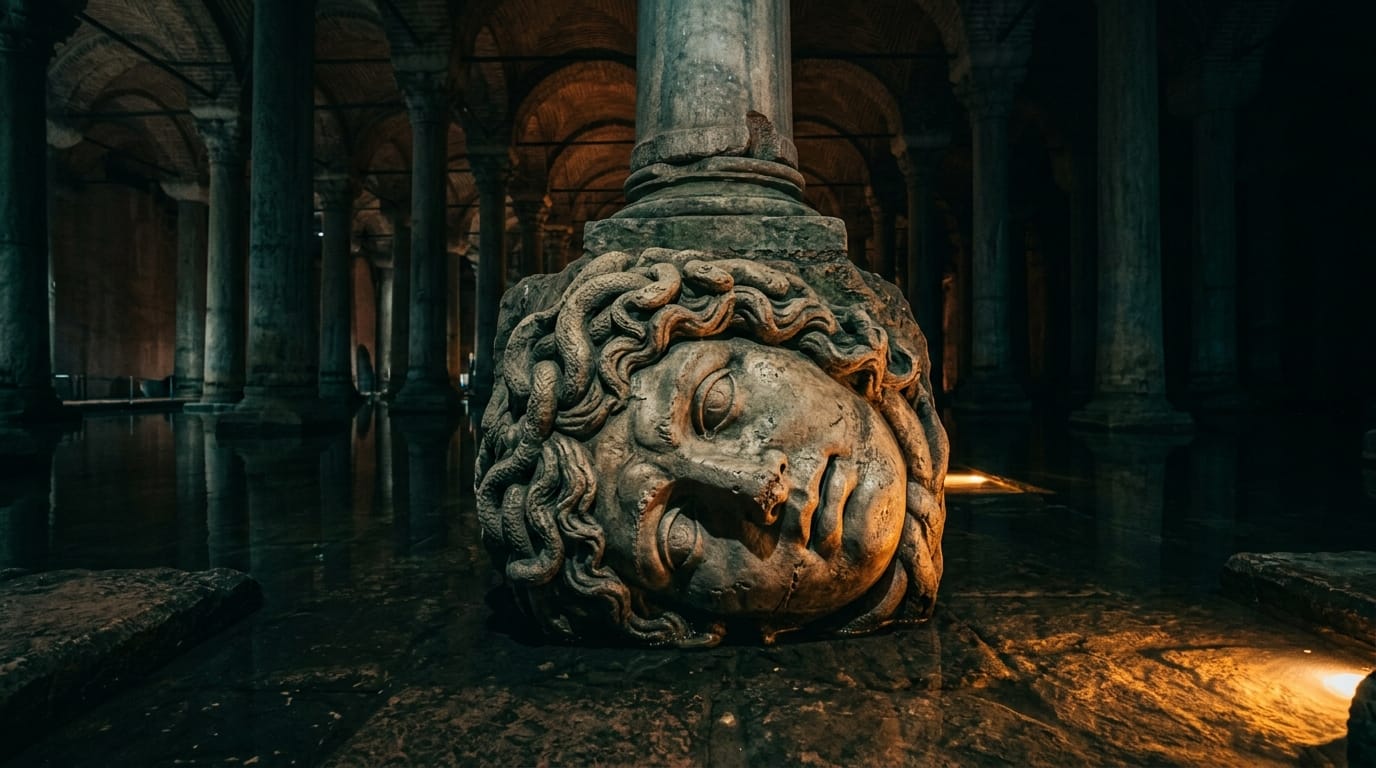
The cistern sits in the heart of the old city, directly across the street from Hagia Sophia — it was built to store water for the Great Palace of the Byzantine emperors, and the columns holding up its roof were recycled from older Roman temples. Its most famous residents are two carved Medusa heads, reused as column bases — one placed upside down, one on its side, for reasons nobody has ever settled. Visits run on raised walkways just above the water (see what to see inside), and when you are ready to go, you can arrange skip-the-line entry through our booking partner.
Why the Basilica Cistern matters
Nothing else in Istanbul feels like it. The city’s great monuments — Hagia Sophia, the Blue Mosque, Topkapı — compete for the skyline; the cistern is their shadow-twin, an underground basilica built with the same imperial ambition but designed never to be seen. It is a masterpiece of Byzantine engineering: four-metre-thick fire-brick walls sealed with waterproof mortar, vaults carried on a forest of mismatched columns salvaged from across the empire, and water brought nearly twenty kilometres from the Belgrade Forest through aqueducts to supply the palace above.
Then the empire fell, and the cistern was simply forgotten — for a century after the Ottoman conquest, people drew water and even fish through holes in their basement floors without knowing what lay below. Its rediscovery in 1545, its slow decay, and the 1980s restoration that pulled 50,000 tonnes of mud out of it are as much a part of the story as Justinian. Hollywood noticed too: James Bond rowed through it in From Russia with Love, and Dan Brown flooded it in Inferno — the films are a story of their own.
Visiting the Basilica Cistern in Istanbul
A visit is short, atmospheric and easy to fit into any Sultanahmet day: most people spend 30–45 minutes underground, and the entrance is two minutes from the tram (see how to get there). It is cool and damp year-round — a welcome escape in summer — and the low light rewards patience more than a rushed loop (our planning guide covers timing, what to wear and the quietest hours). Since the 2022 restoration the cistern also opens on summer evenings, when the crowds thin and the lighting turns theatrical — worth considering if you like your Byzantine engineering after dark. Entry is ticketed for everyone; to avoid the ticket-office queue, you can reserve your entry in advance.
Explore the guide
The Medusa Heads
One upside down, one sideways — the cistern’s strangest sight and the theories behind it.
History
Justinian’s reservoir of 532 AD, a thousand years of oblivion, and the sunken palace today.
What to See Inside
The column forest, the Hen’s Eye column, the carp in the water and the amber light.
Photos
What the cistern really looks like: columns, reflections, walkways and Medusa — in pictures.
Opening Hours
Daily visiting times, the evening programme and the quietest hours to go underground.
How to Get There
The entrance opposite Hagia Sophia, tram T1, and walking routes from the old city.
Plan Your Visit
How long it takes, what to wear underground, best times and what to combine it with.
Stories & deep dives
- Is the Basilica Cistern Worth Visiting? An Honest Review
Is the Basilica Cistern worth it? An honest review of what visitors love, what disappoints, what reviews actually say, and who should visit.
- Movies Filmed in the Basilica Cistern: Bond to Inferno
The Basilica Cistern on screen: James Bond in From Russia with Love, the flooded finale of Inferno, and how film shaped the cistern's fame.
- Basilica Cistern at Night: Evening Visits & Concerts
Visiting the Basilica Cistern at night: how the evening programme works (roughly 19:30–22:00), how it differs from daytime, and the concerts among the columns.
- Hagia Sophia and the Basilica Cistern in One Day
How to visit Hagia Sophia and the Basilica Cistern together — they are 150 metres apart. A timed one-day Sultanahmet itinerary with the smartest order.
- Basilica Cistern vs Theodosius Cistern: Which to Visit?
Basilica Cistern or Theodosius Cistern (Şerefiye)? How Istanbul's two great visitable cisterns compare on atmosphere, history, crowds and time.
Frequently Asked Questions
What is the Basilica Cistern?
The Basilica Cistern is a huge underground water reservoir in Istanbul, built in 532 AD under the Byzantine emperor Justinian I. Known in Turkish as Yerebatan Sarnıcı, the "sunken cistern," it once held about 80,000 cubic metres of water for the Great Palace, and today visitors walk on raised walkways through its lamp-lit forest of 336 marble columns.
Why are the Medusa heads upside down and sideways?
Nobody knows for certain. The two Medusa heads reused as column bases were almost certainly recycled from an older Roman building, and the practical explanation is that they simply fit best that way. Popular theories add that placing Medusa inverted neutralised her petrifying gaze — either builder superstition or a Christian-era dismissal of a pagan image.
How long does a visit to the Basilica Cistern take?
Most visitors spend 30 to 45 minutes inside. The walkway route is a single gentle loop past the column forest, the Medusa heads in the far corner and the Hen's Eye column. Add queue time in high season — midday lines can be long, so early morning or evening is calmer.
Do you need a ticket to enter the Basilica Cistern?
Yes. The cistern is run by the Istanbul Metropolitan Municipality and entry is ticketed for everyone — it is not covered by Museum Pass Istanbul and it is never free. Buying online in advance means you skip the ticket-office queue, which matters in high season.
More questions — photography, accessibility, whether it’s worth it — are answered in the full Basilica Cistern FAQ.