
Movies Filmed in the Basilica Cistern: Bond to Inferno
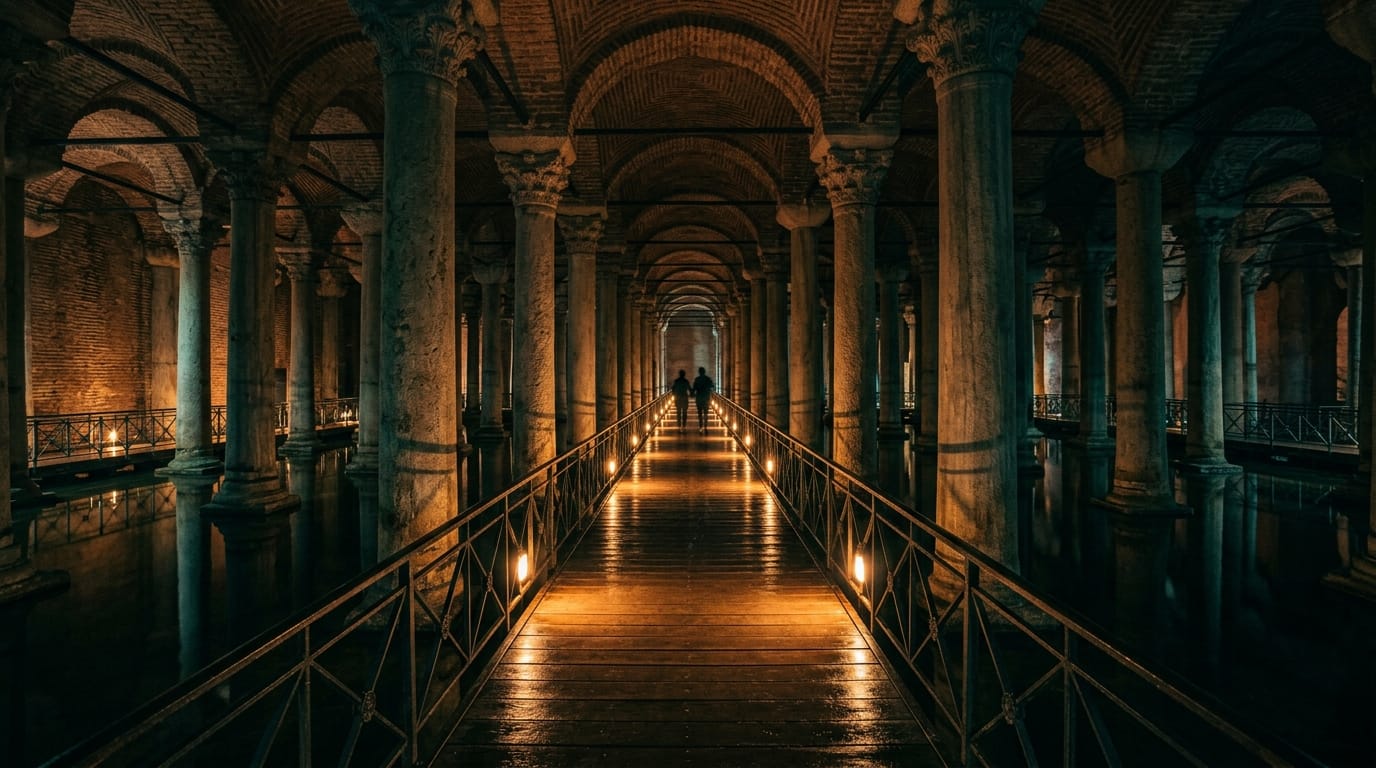
The Basilica Cistern has been a movie star since 1963, when Sean Connery’s James Bond rowed a boat between its columns in From Russia with Love — and it returned to global screens in 2016 as the flooded setting for the finale of Inferno, Ron Howard’s Dan Brown adaptation. No other monument in Istanbul has this particular kind of fame: millions of people saw the sunken palace on screen before they knew what it was called. This is the cistern’s filmography, what was really shot down there, and what film-fans should look for on a visit.
From Russia with Love (1963): Bond under the streets
The second James Bond film gave the cistern its screen debut and its most enduring image. In the story, Bond and the Turkish intelligence chief Kerim Bey pole a small boat through a flooded underground chamber to reach a periscope spying on the Soviet consulate — “the Russians built their consulate right over one of the old cisterns,” runs the conceit. The columns gliding past in torchlight are the real Basilica Cistern: the production filmed in Istanbul in April 1963, and the cistern sequence stitched location footage with sets at Pinewood.
Two details make the scene a period piece now. First, Bond travels by boat — which is how the cistern was actually visited until the 1980s, when the mud was dredged and the raised walkways were built (that story is here). Second, the geography is cheerfully invented: the real cistern is under Sultanahmet, nowhere near the old Soviet consulate in Beyoğlu. Sixty years on, fans still descend the same 52 steps Bond’s boat made famous.
Inferno (2016): Dan Brown floods the cistern
Dan Brown’s novel Inferno stages its climax in the cistern — a bioweapon suspended in a submerged chamber, found via the clue “the sunken palace… where Medusa lies” — and Ron Howard’s film adaptation with Tom Hanks brought the location to screen. The production shot at the real cistern, then rebuilt it at scale in a Budapest studio tank for the flooded action finale, complete with replica columns and a replica Medusa head.
The film takes liberties (the real water is knee-deep, not diveable, and the acoustics would defeat any whispered conspiracy), but it is affectionate about the details: the inverted Medusa gets a proper close-up, and the “sunken palace” nickname — Yerebatan Sarayı — carries the plot. Visitor numbers jumped noticeably after both the novel and the film; guides still field “where was Inferno?” daily.
The rest of the reel
- The Accidental Spy (2001): Jackie Chan’s action-comedy stages a fight sequence in the cistern — the most physical use of the location on film, walkways and all.
- Assassin’s Creed: Revelations (2011): not a film, but for a generation of players this videogame’s meticulously modelled Constantinople put the cistern on the mental map before any documentary did; its version is explorable, climbable and full of secrets.
- Television and documentaries: the cistern is a fixture of every major Istanbul travel series — Rick Steves, Bourdain-era food-travel shows, and countless Byzantine history documentaries have all shot between the columns.
The through-line: filmmakers use the cistern to mean the hidden past under the modern city — which happens to be exactly what it is.
Why the cistern works on camera
Cinematographers get something for free down here that money struggles to build: repetition with mystery. Twelve rows of twenty-eight columns give every shot depth and rhythm; the water doubles every light source; and the darkness swallows the edges of the frame, so the space reads as infinite. The 2022 relighting made the effect stronger still — the current amber scheme is pure film noir, and ordinary phone footage from the walkways now looks graded. (Photographers: our photo guide covers how to work with that light.)
There is also the Medusa factor. A monster’s severed head, upside down in the dark under a city — no screenwriter has ever had to improve that premise. The real story behind the heads is arguably stranger than any of the fictions built on it.
Visiting as a film fan
Everything the movies used is on the standard visitor route:
- The Bond view: mid-loop, look down the long column aisles at water level — that receding torchlit perspective is the 1963 shot, minus the boat.
- The Inferno set piece: the far northwest corner, where “Medusa lies.” The inverted head from the film’s climax is the real one.
- The echo: pause and listen. The dripping, layered reverb you hear in every one of these films needed no sound design.
The cistern rewards film pilgrims best when it is quiet — at a crowded midday you are an extra in someone else’s crowd scene. Go at opening or in the evening session, and the set is yours: skip-the-line entry is arranged here. Sixty years of cinema agree on one thing — the sunken palace plays best in low light with a small cast.