
The Medusa Heads
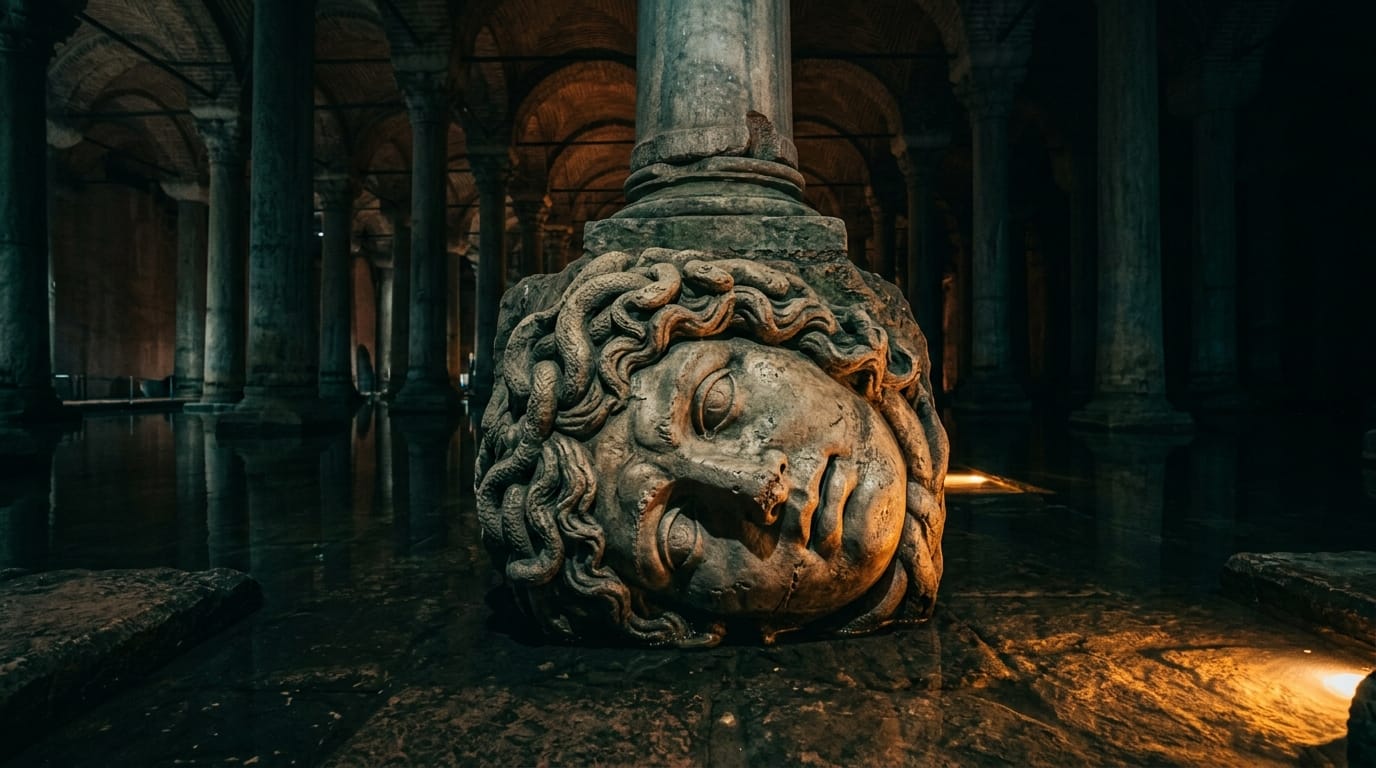
In the far northwest corner of the Basilica Cistern, two marble Medusa heads serve as column bases — one lying on its side, the other placed completely upside down. They are the most photographed objects in the cistern and among the strangest sights in Istanbul: the severed head of a Greek monster, carved centuries before the cistern existed, pressed into service as a building block and left staring into the water for 1,500 years. Nobody recorded where they came from or why they were set at those angles, which is exactly why people have been arguing about them ever since.
This page covers what the heads are, the three main theories about their placement, and how to see them on your visit.
Who was Medusa, and what is her head doing in a cistern?
Medusa was the mortal one of the three Gorgon sisters of Greek myth — a woman with living snakes for hair whose gaze turned anyone who met it to stone. The hero Perseus beheaded her using a polished shield as a mirror, and her severed head kept its petrifying power, which is why Gorgon faces appear all over the ancient world: carved onto temples, shields, doorways and tombstones as apotropaia — protective images meant to turn evil away.
That protective tradition is the key to understanding why a Medusa carving existed in the first place. What it does not explain is how two of them ended up nine metres underground, holding up columns in a waterworks.
Where did the two heads come from?
The honest answer: nobody knows. The heads were almost certainly not carved for the cistern. When Justinian I’s engineers built it in 532 AD, they worked fast and economically, salvaging 336 columns, capitals and bases from older Roman buildings across the empire — a practice called spolia, visible throughout the cistern in its mismatched column forest. The Medusa heads are simply the most dramatic pieces of that salvage operation.
Their carving style points to a late Roman-era building — a temple, a nymphaeum or a monumental gate — but the source has never been identified. By the sixth century, the empire was Christian; pagan temples were quarries, and a block was a block. Two Gorgon heads happened to be the right height to level two short columns in a dark corner where, as far as the builders knew, no one would ever look at them again.
Why is one upside down and one sideways?
Three explanations compete, and the cistern is more fun if you know all of them.
The practical theory
The engineering answer, and the one most historians favour: the heads are the right size at those angles. Each head levels a column that would otherwise have been too short, and a block is most stable when its widest, flattest face sits down. The builders were solving a height problem in a dark utility basement, not composing a gallery display. Roman construction reused older stone this way constantly — the only unusual thing here is that the recycled blocks have faces.
The superstition theory
The version every guide tells, because it is irresistible: Medusa’s gaze petrified, so the builders inverted the heads to neutralise her power. Turned upside down or sideways, she cannot meet your eye, and her magic is cancelled. There is no Byzantine text that says this — but the apotropaic logic is genuinely ancient, and even a Christian work crew in 532 AD might have preferred not to take chances with a Gorgon they were about to submerge in the dark.
The statement theory
A third reading sees deliberate symbolism: a Christian empire literally overturning a pagan idol, placing the old gods face-down under the water that served the imperial palace. The empire did make statements like this elsewhere. Against it stands an awkward fact — the cistern was a sealed waterworks nobody was meant to see, an odd venue for propaganda.
Most likely, the truth is the boring theory wearing the interesting ones as a mask: the heads fit, and the stories grew later. But standing in front of them, half-lit above black water, the practical explanation is somehow the hardest one to believe.
Finding the Medusa heads on your visit
The heads sit at the far northwest corner of the cistern — the back-left extremity of the walkway loop, and deliberately the climax of the route. Follow the raised walkway through the column forest to its farthest corner; the two columns stand a few metres apart, each with a viewing area in front. The upside-down head is the first you reach; the sideways head sits just beyond it.
Practical notes:
- Expect a short queue at the viewing platforms in high season — this is the one spot where everyone stops. Early morning and evening visitors often have the corner to themselves; the quietest hours are covered here.
- Photography is allowed and the heads are lit for it, but the light is low — hold still, brace on the railing and skip the flash (it flattens the carving and annoys everyone). More camera advice is in our photo guide.
- Look for the water level marks on the columns around the corner — the cistern once held water above head height, meaning the Medusas spent most of their working life completely submerged.
Worth knowing before you go
The Medusa heads are a two-minute stop at the end of a thirty-minute visit — but they are the two minutes you will remember, and for many visitors they are the reason to come at all. If you are weighing the whole experience, our honest take on whether the cistern is worth visiting covers it, and the history page explains the world that produced both the cistern and its strange guardians.
One last practical point: the Medusa corner is the far end of a one-way flow, and on busy afternoons the walkway between you and it moves slowly. Going early — or reserving skip-the-line entry so you are underground before the queues build — is the difference between meeting Medusa’s gaze alone and photographing the back of forty heads that still have their bodies.