
What to See Inside the Basilica Cistern
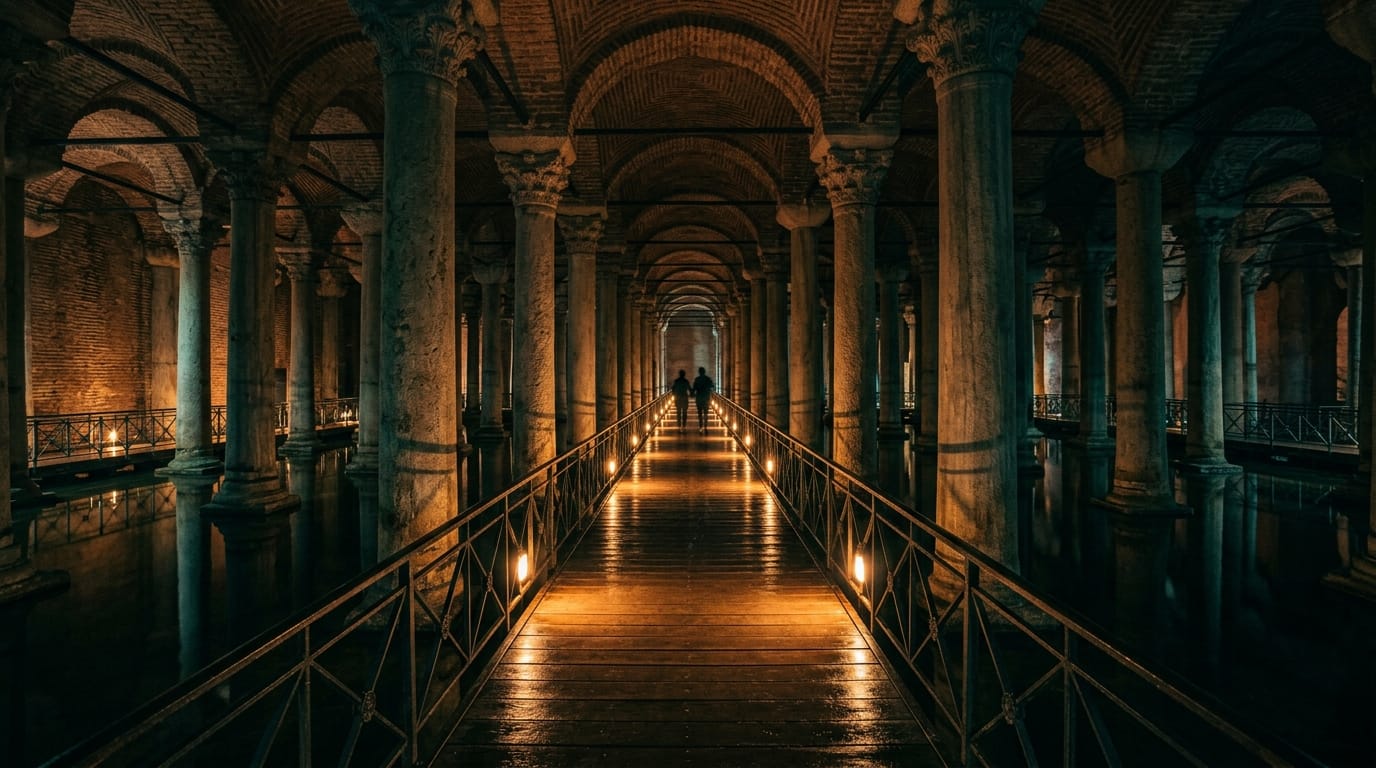
Inside, the Basilica Cistern is a single vast room: 336 marble columns rising out of shallow black water, brick vaults overhead, and a raised walkway that loops you through the dark from the entrance stairs to the Medusa heads and back. There are no side chambers, no exhibits behind glass, no long explanatory panels — the building itself is the exhibit. That makes it one of the easiest great monuments in Istanbul to visit, and one of the easiest to rush. This page walks the route in order, so you know what you are looking at and where to slow down.
The descent: 52 steps down
The visit begins with a plain doorway on Yerebatan Caddesi and a stone staircase of 52 steps. The temperature drops as you go — the cistern holds a cool, damp climate all year, a shock in August and a mercy in every direction (bring a layer; details in plan your visit). At the bottom, the room opens up all at once: nine-metre columns in every direction, their tops disappearing into vaulted shadow, their bases doubled in the water.
The column forest
The cistern’s 336 columns stand in twelve rows of twenty-eight, spaced just under five metres apart, and no two are quite alike. Justinian’s engineers built with spolia — columns, capitals and bases salvaged from older Roman buildings across the empire — so a fluted shaft stands beside a smooth one, a Corinthian capital beside a plain block. It gives the room a strange, dreamlike quality once you notice it: an army in mismatched uniforms.
Look up as well as ahead. The brick cross-vaults form a repeating canopy, and the wall bricks — four metres thick, sealed with waterproof mortar — still show the horizontal water-level stains from fourteen centuries of service. The water beneath the walkways is deliberately kept shallow today, less than knee-deep in most places; when the cistern worked for a living, it held water many metres deep, submerging most of what you are now walking through.
The Hen’s Eye column — the Column of Tears
Partway along the route, one column breaks the pattern: its surface is carved all over with raised, branching motifs that read as eyes brimming over, or peacock feathers — usually called the Hen’s Eye column or the Column of Tears. Its pattern matches columns from the 4th-century Forum of Theodosius, whose ruins lie along modern Ordu Caddesi, which is almost certainly where it came from.
The legend is better than the archaeology: the teardrops are said to weep for the hundreds of enslaved labourers — tradition says 7,000 worked here — who died building the cistern. There is a folk custom of putting a thumb in one of the holes in the column and rotating your hand for luck. Do it or don’t; the polish on the stone says plenty of people do.
The Medusa heads
At the far northwest corner of the loop wait the cistern’s celebrities: two carved Medusa heads, recycled as column bases — one upside down, one on its side. They have their own full page, covering where they might have come from and the three competing theories about their placement. On the route itself, know this much: they are at the farthest point of the walkway, they are worth the whole visit, and the viewing platforms in front of them are the one place inside where a queue forms.
The water — and the carp
The shallow water is not decoration; it keeps the cistern’s climate and masonry stable, and it is inhabited. Shoals of carp cruise between the column bases, descendants of stock kept here for centuries — folklore says Byzantine caretakers used fish as living water-quality alarms, and the fish that Ottoman-era locals pulled up through their basement floors were what led Petrus Gyllius to rediscover the cistern in 1545. Watch the water along the darker stretches of walkway: the fish find you before you find them, materialising out of black water into the pools of amber light.
The lighting and the art
Since the 2017–2022 restoration, the cistern has been lit low and warm — a candlelight-amber scheme that pools around column bases and leaves the vaults in shadow. It is theatrical by design, shifting subtly through the visit, and it is the main reason photographs from the cistern look the way they do (our photo guide covers how to shoot in it). Scattered among the columns you will also find contemporary sculptures added since the reopening — glass jellyfish, carved hands, figures standing in the water. Opinions divide; the columns outnumber them comfortably either way.
How long the route takes
The walkway is a single self-guided loop with no decisions to make. At a steady pace it takes 20 minutes; at the pace the room deserves, 30–45. There are no toilets or cafés underground and re-entry is not possible, so finish above ground business first. The full practical rundown — timing, what to wear, combining the cistern with Hagia Sophia next door — is in plan your visit, and the current opening hours are here.
One honest tip: the room rewards the unhurried. Most visitors sweep through in a tour-group wave, photograph Medusa and climb out. Let a wave pass, stand still in the middle rows, and for a minute or two the sunken palace is yours — 1,500 years old, holding up a city street, quietly dripping. When you are ready to claim your own half hour underground, reserve your entry ahead of time and go early or late, when the forest is at its emptiest.