
History of the Basilica Cistern
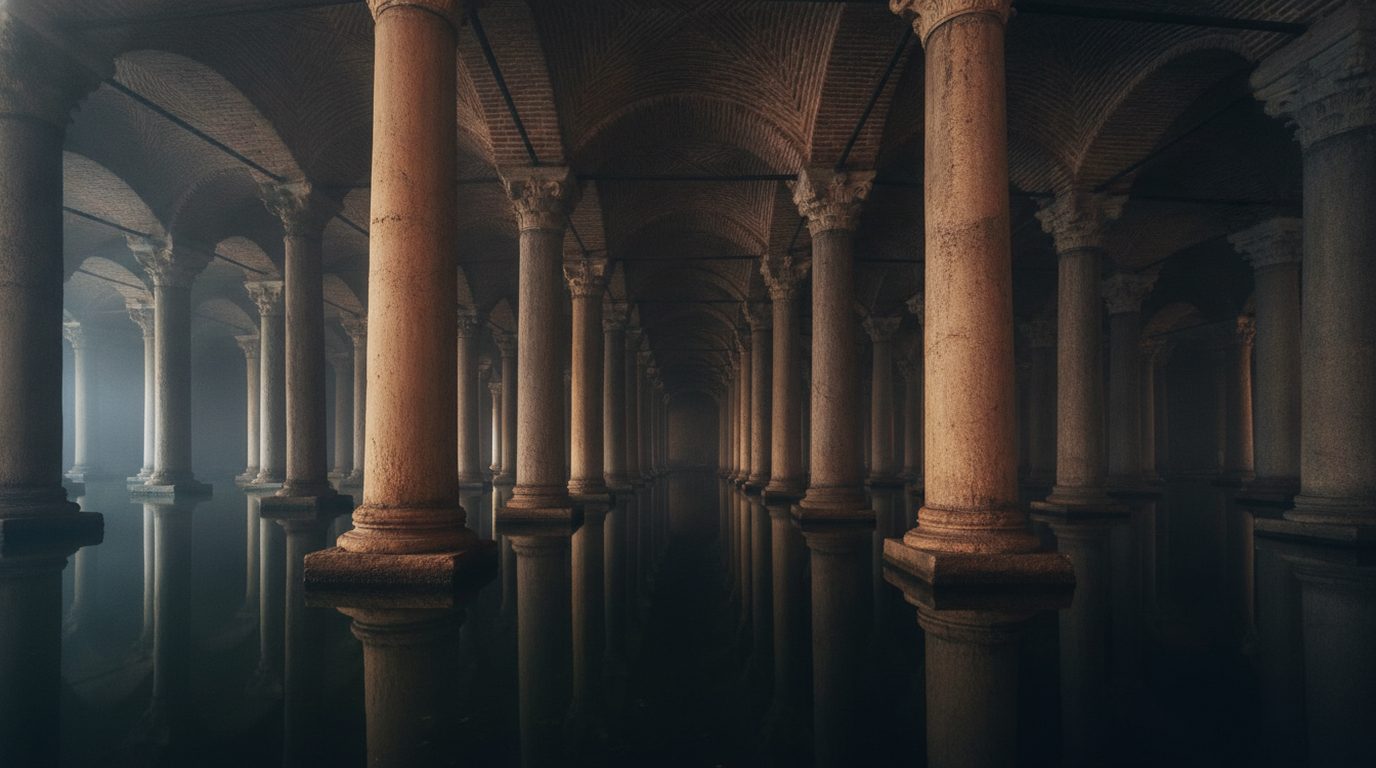
The Basilica Cistern was built in 532 AD under the Byzantine emperor Justinian I, as the largest covered water reservoir of Constantinople — a working piece of imperial infrastructure that outlived the empire that made it. It stored water for the Great Palace and its surrounding district, was forgotten for a century after the Ottoman conquest, was rediscovered by a curious scholar following rumours of fish under people’s floors, and reopened in its current form as one of Istanbul’s most visited monuments. Few buildings anywhere have a stranger career: a millennium of quiet service, a century of oblivion, and an afterlife as a stage set.
Why was the Basilica Cistern built?
Constantinople had a water problem. The city sits on a peninsula with no river, and its springs could never supply a capital of half a million people — so the Byzantines built one of the great water systems of antiquity: aqueducts reaching nearly twenty kilometres into the Belgrade Forest, feeding hundreds of cisterns beneath the city. Water arrived via channels linked to the Valens Aqueduct, whose surviving arches still stride across modern Istanbul.
The largest of those cisterns was built after the Nika riots of January 532, which burned much of the city centre (including the church that Hagia Sophia was rebuilt to replace). As Justinian rebuilt, he secured the water supply of the imperial quarter: a covered reservoir of about 138 by 65 metres — nearly 9,800 square metres — able to hold roughly 80,000 cubic metres of water for the Great Palace and the buildings around the Hippodrome. Byzantine sources say seven thousand labourers worked on it.
The name is a location, not a description: the cistern was dug beneath the Stoa Basilica, a great colonnaded public square and law-court complex on the peninsula’s first hill. The basilica above vanished centuries ago; its basement became one of the most famous places in Türkiye.
How it was built
The engineering is straightforward in principle and staggering in execution:
- The walls are fire-brick, four metres thick, sealed inside with a waterproof lime mortar that still does its job.
- The roof is a grid of brick cross-vaults carried on 336 marble columns — twelve rows of twenty-eight, each about nine metres tall, spaced under five metres apart.
- The columns are salvage. Justinian’s builders recycled columns, capitals and bases from older Roman structures across the empire — which is why Ionic, Corinthian and plain capitals stand side by side, why one column carries mysterious teardrop carvings, and why two reused blocks in the far corner turned out to be Medusa heads.
The result was never meant to be seen. No mosaics, no dedication, no audience — a cathedral-sized space built for water and darkness. That unintended grandeur is what visitors respond to today.
A thousand years of service, a century of oblivion
The cistern worked through the entire remaining life of Byzantium, supplying the palace quarter through sieges, sackings — including the Fourth Crusade in 1204 — and slow decline. After Mehmed II took the city in 1453, the Ottomans built their own excellent water systems and preferred running water to stored; the palace moved to Topkapı, which drew garden water from the old cistern for a time, and the reservoir under the first hill gradually slipped out of institutional memory. Above it, houses went up. Within a few generations, no one in the neighbourhood knew it existed.
The rediscovery is the best story in the building’s history. In 1545, the Dutch-French scholar Petrus Gyllius was in Istanbul cataloguing Byzantine remains when he noticed locals in the Hagia Sophia district drawing water from holes in their basement floors — some even catching fish from them. Following the rumours, he found a house whose cellar opened onto black water, took a boat down through it, and measured a column forest by torchlight. His published account returned the cistern to the world’s knowledge — though for centuries afterwards it remained a dumping ground and, by some accounts, a place bodies ended up.
The Yerebatan name
The Turkish name, Yerebatan Sarnıcı, means “the sunken cistern” — from yere batan, literally “sunk into the ground.” The affectionate older name, Yerebatan Sarayı, “the sunken palace,” captures how the place feels better than any technical term. Pronunciation is easier than it looks: yeh-reh-bah-TAHN sahr-nuh-juh. English kept the Byzantine location-name instead — the cistern of the Basilica — which is why the same building answers to both “Basilica Cistern” and “Yerebatan” depending on who you ask. Both names are correct; the street outside, Yerebatan Caddesi, takes the Turkish one.
Restorations: from mud to museum
The Ottomans repaired the structure at least twice — notably in 1723 under the architect Muhammed Ağa of Kayseri and again in the nineteenth century under Abdülhamid II — but the modern cistern is the product of two great campaigns:
- 1985–1987: the Istanbul municipality hauled out some 50,000 tonnes of mud and silt, installed the raised walkways that replaced tourist rowboats, and opened the cistern to the public on 9 September 1987.
- 2017–2022: a five-year structural restoration reinforced the cistern against earthquakes, cleaned the columns, and replaced the lighting with the current low amber scheme. It reopened on 23 July 2022, with contemporary art installations placed among the columns — a jellyfish here, a glass hand there — that now share the darkness with Medusa.
Timeline at a glance
| Year | Event |
|---|---|
| 532 AD | Built under Justinian I after the Nika riots, beneath the Stoa Basilica |
| 1204 | Constantinople sacked by the Fourth Crusade; the cistern serves on |
| 1453 | Ottoman conquest; the cistern gradually falls out of use and memory |
| 1545 | Rediscovered by Petrus Gyllius via basement wells and cellar fish |
| 1723 | Ottoman restoration under Muhammed Ağa of Kayseri |
| 1985–1987 | Mud cleared, walkways built; opens to the public |
| 2017–2022 | Full structural restoration; reopens with new lighting |
Standing in it today
History is the reason a half-hour underground walk feels bigger than it should: you are inside the water supply of an empire, under the floor of a vanished courthouse, in a room that spent a hundred years as a rumour. To see how the engineering plays out column by column, continue to what to see inside; to stand in front of the two strangest survivors of Justinian’s salvage operation, go straight to the Medusa heads. And when you are ready to descend the 52 steps yourself, arrange your entry in advance — the queue above ground is the only part of the experience Justinian didn’t engineer.