
Basilica Cistern Photos
What does the Basilica Cistern actually look like? These photos walk the visit in order — the column forest that opens up at the bottom of the stairs, the walkway over the water, the reflections, the Medusa head at the far corner, and the easy-to-miss street entrance where it all starts. Every picture shows something you will see on the standard visitor route.
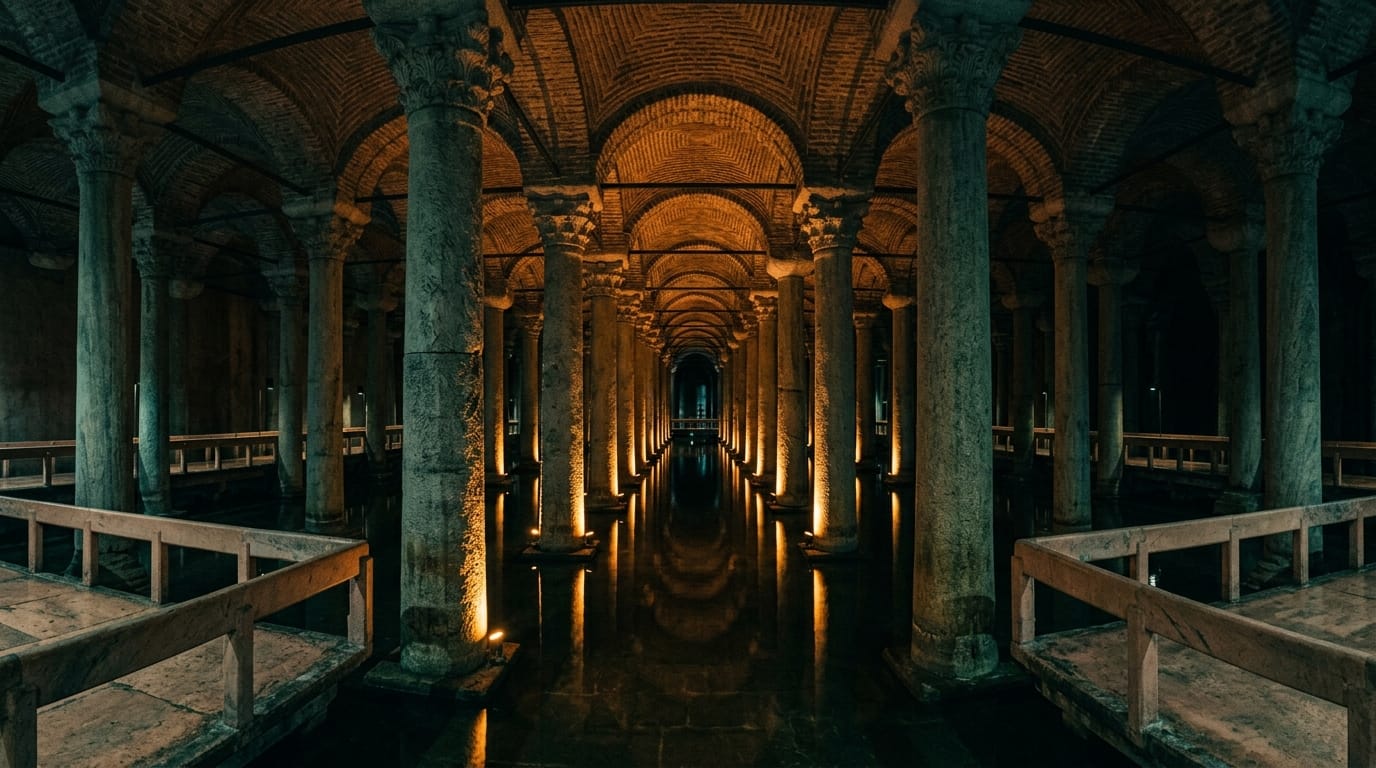
The column forest
The signature view of the Basilica Cistern: 336 marble columns in twelve rows, holding brick vaults above shallow black water — Justinian’s reservoir of 532 AD.
This is what greets you at the bottom of the 52 entrance steps. The columns were salvaged from older Roman buildings across the empire, which is why no two aisles quite match. The far edges of the room dissolve into darkness by design — the amber lighting pools low, leaving the vaults in shadow.
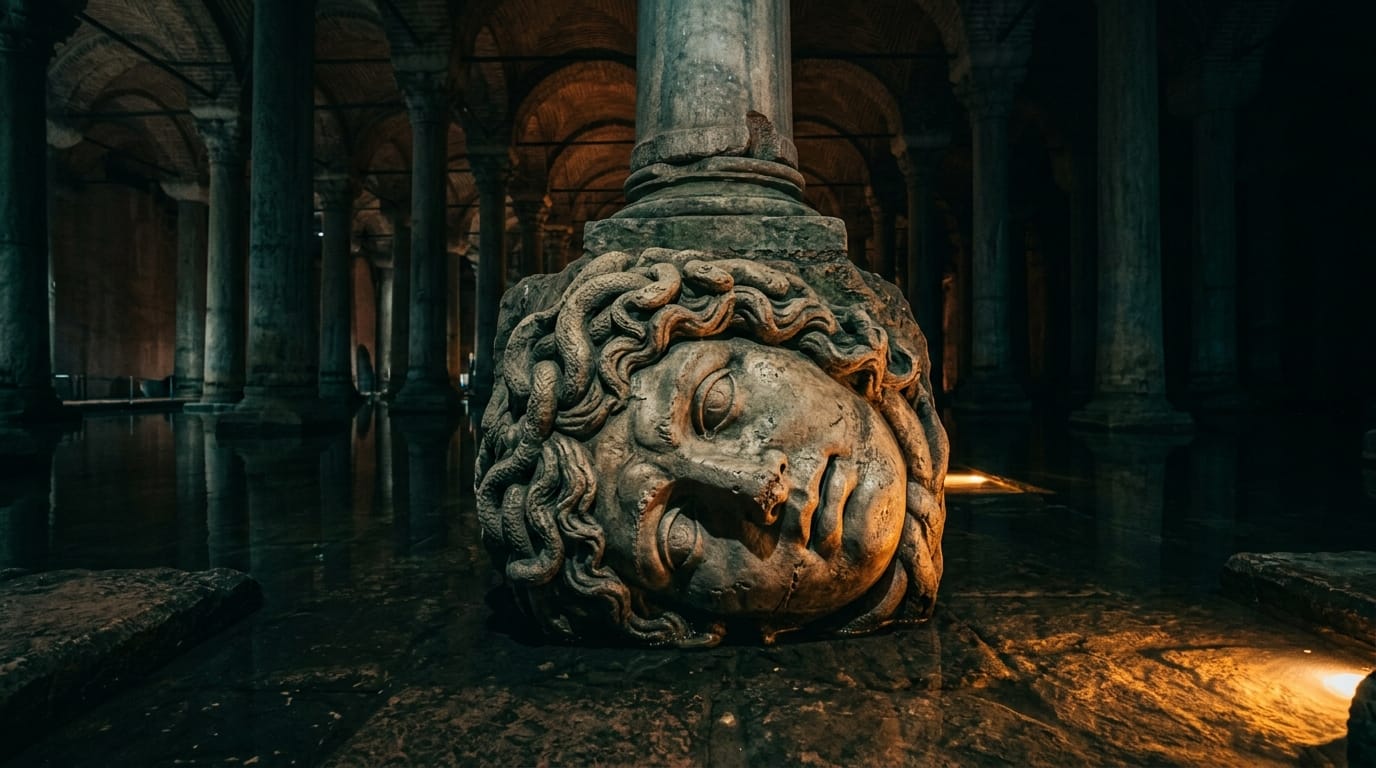
The Medusa head
One of the cistern’s two Medusa heads, recycled as a column base in the far northwest corner — one lies sideways, the other fully upside down.
The most photographed stone in the cistern. Nobody knows which Roman building the heads came from or why the builders set them at these angles: the practical theory says they simply fit, the popular one says inverting Medusa neutralised her gaze. Both heads sit at the far end of the walkway loop, where a short queue forms at the viewing platforms.
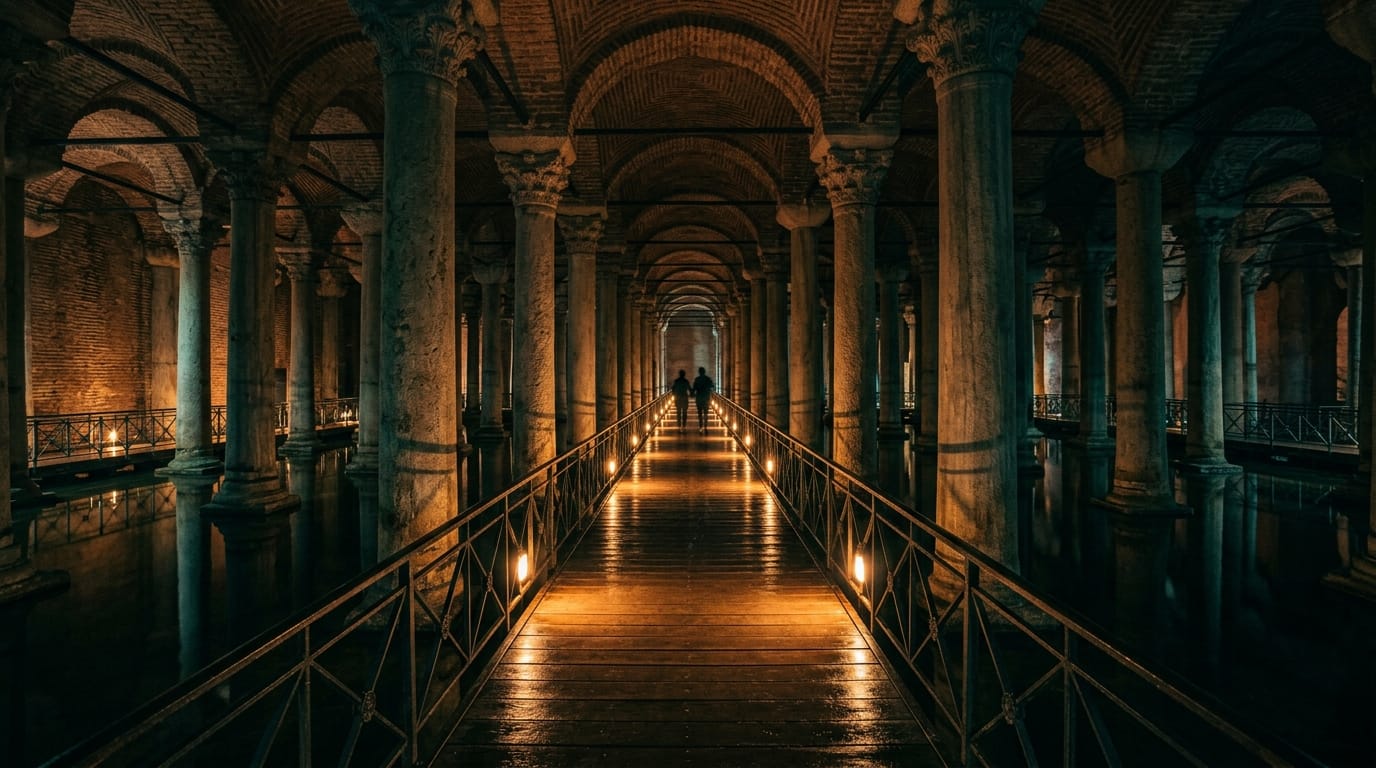
The walkway through the dark
The raised walkway loop, installed in the 1980s restoration — before it, visitors toured the cistern by rowing boat, as James Bond did in 1963.
The route is a single gentle loop with no decisions to make: through the column forest, out to the Medusa corner, and back. The walkways sit just above the water, so the columns double in reflection on both sides of your path. Surfaces stay damp year-round — grippy shoes are the one piece of gear that matters.
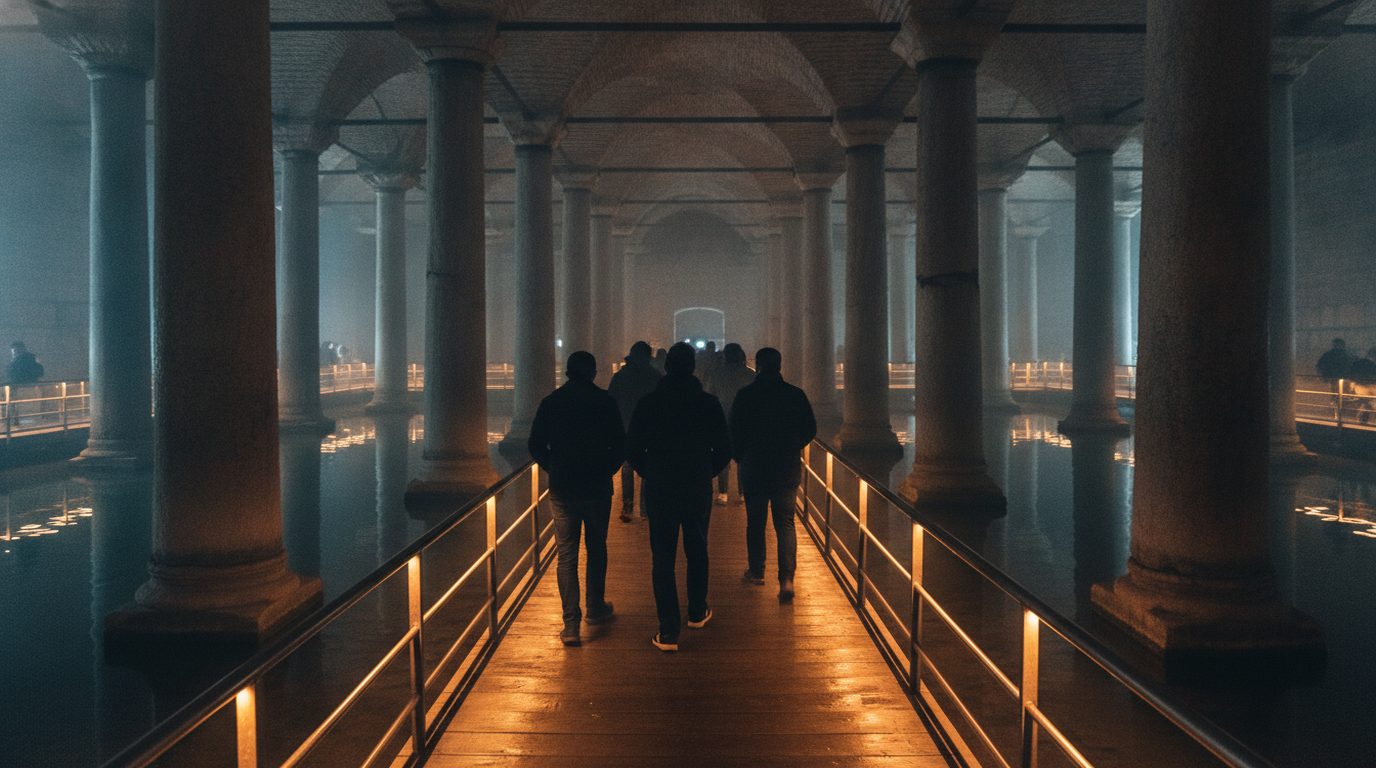
On the walkway
Scale, from inside the visit: the railed walkway holds you just above the water while nine-metre columns disappear into the vaulted dark overhead.
This is what the visit feels like at eye level. The loop is wide enough to pause without blocking anyone, and the lighting is aimed low — at railings, bases and water — so the room stays dark above your head. Come at 09:00 and you may have a stretch like this to yourself; at midday, expect a steady file of visitors in both directions.
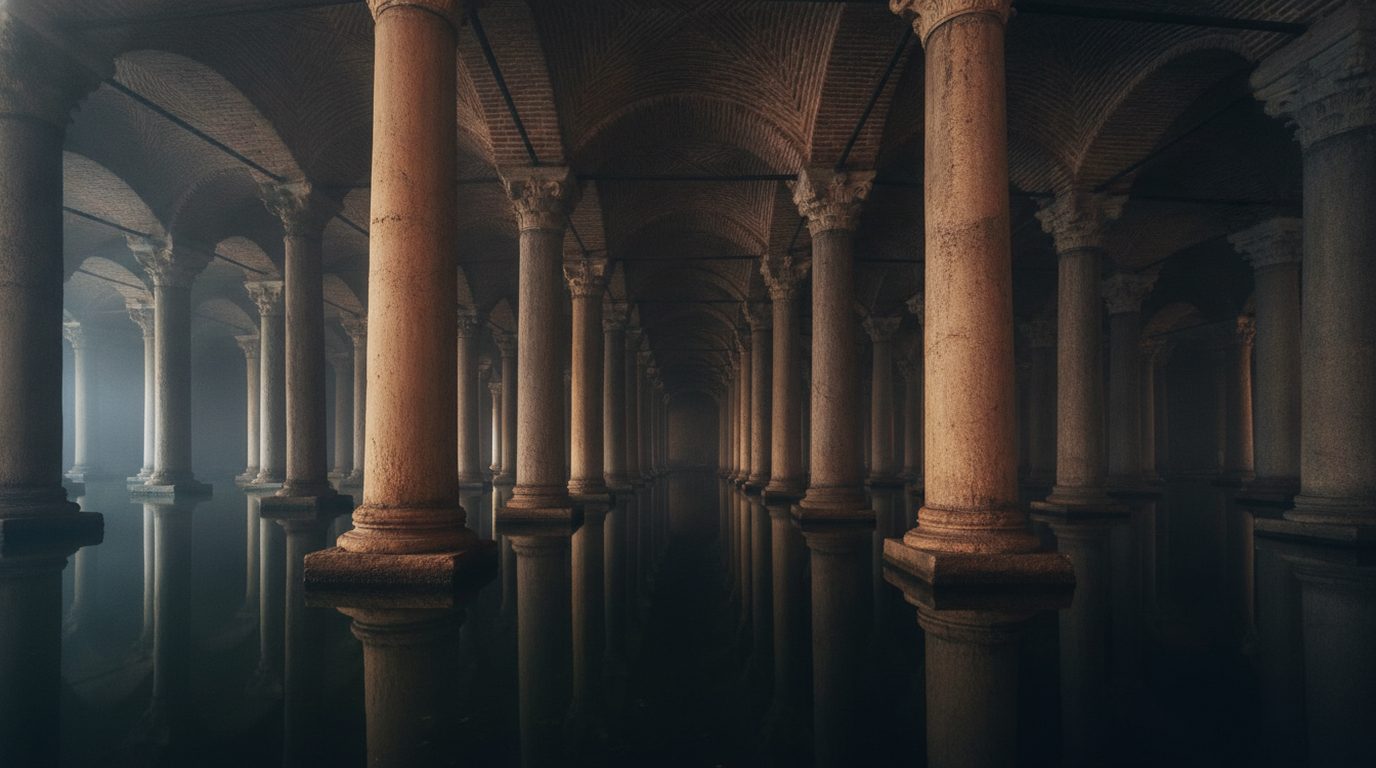
The vaults: Byzantine engineering overhead
Justinian’s engineers roofed the reservoir with fire-brick vaults on 336 salvaged columns — the same imperial construction, designed never to be seen.
Look up between photographs: the herringbone brickwork overhead is original 6th-century engineering, sealed with waterproof mortar and carried on capitals looted from older temples across the empire. The mismatched columns — fluted beside smooth, Corinthian beside plain — are the giveaway that this cathedral-sized room was built as pure infrastructure.
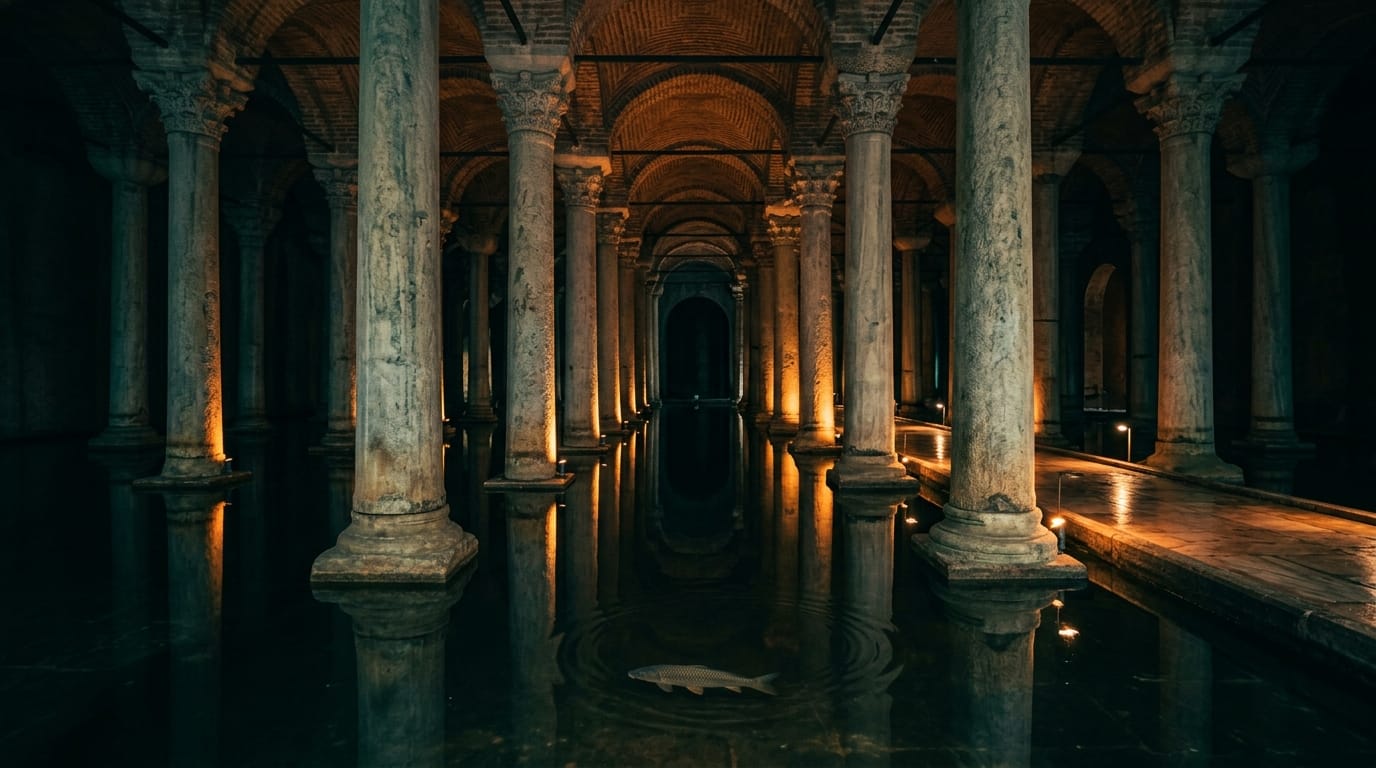
Reflections on the water
Still, knee-deep water doubles every column and every lamp — the cistern once held water many metres deep, submerging most of what visitors now walk through.
The water is the room’s second architect. Kept shallow today, it holds the cistern’s cool climate, mirrors the amber light, and hosts shoals of carp that materialise out of the dark — descendants of fish kept here for centuries, and the very clue that led Petrus Gyllius to rediscover the forgotten cistern in 1545.
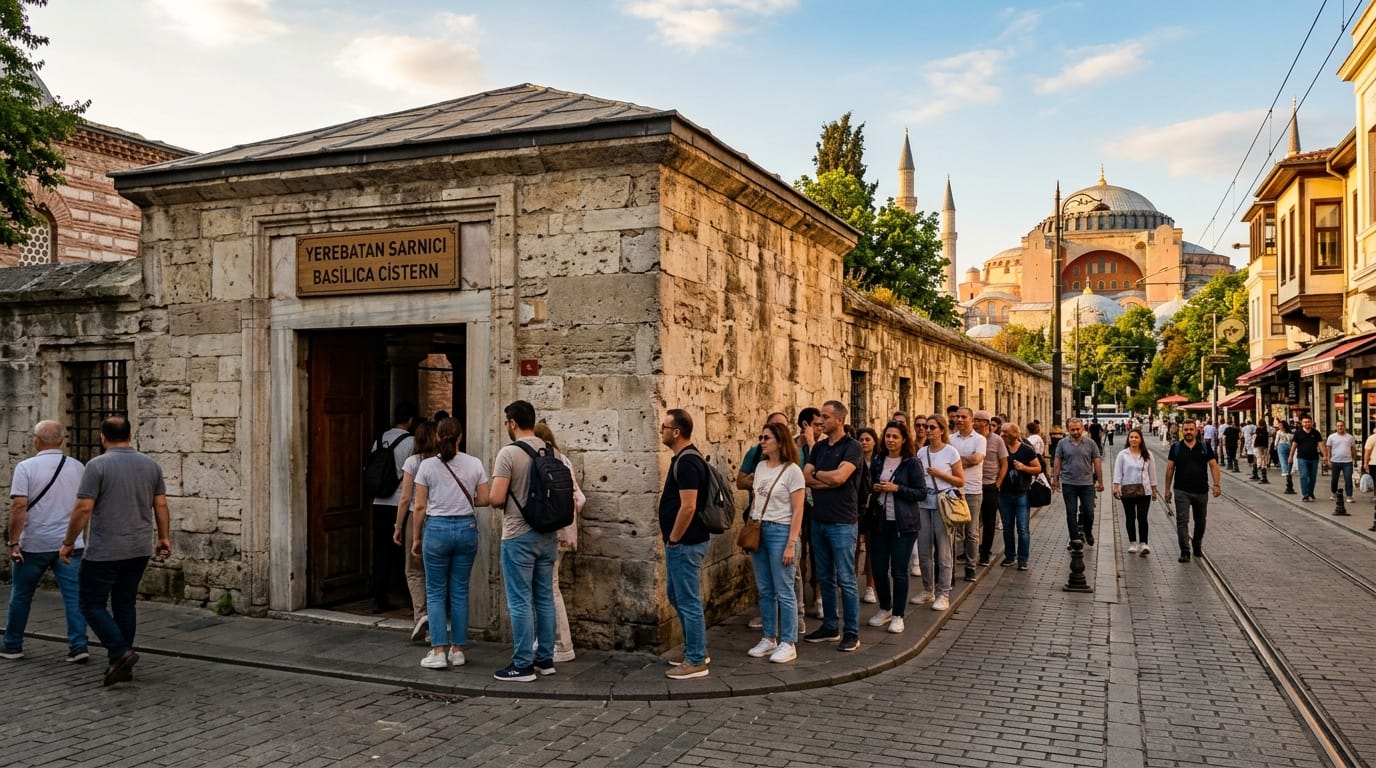
Outside: the entrance on Yerebatan Caddesi
All you see from the street: the modest entrance pavilion on Yerebatan Caddesi, directly opposite Hagia Sophia — the cathedral-sized cistern hides under the block behind it.
The least dramatic photo in this set is the one you need most: the cistern is invisible from street level, and first-time visitors regularly walk past it. Find Hagia Sophia’s northwest corner, cross the tram street, and look for this doorway — and usually for the queue beside it, which is the strongest argument for arriving at 09:00.
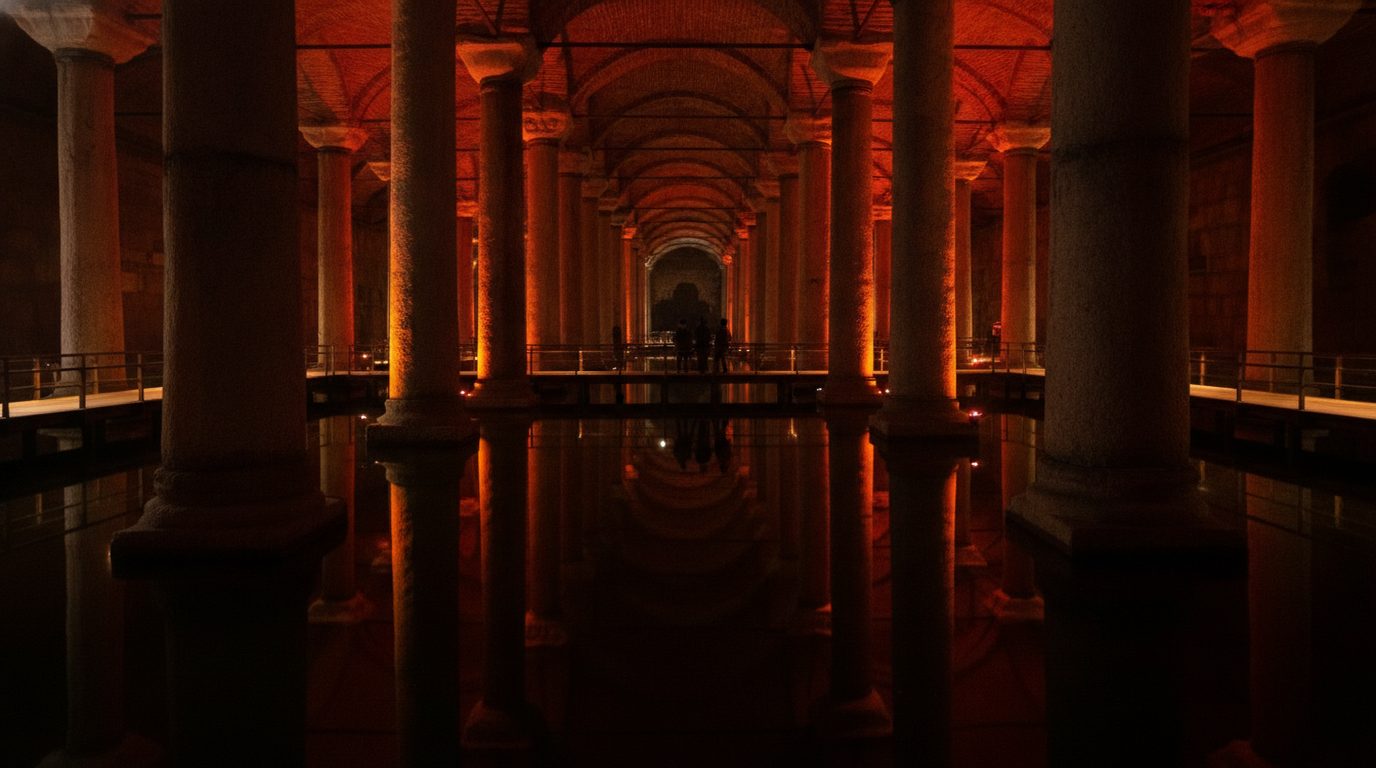
The evening programme
After daytime closing, the cistern reopens (roughly 19:30–22:00) under a warmer, more theatrical light design — the sunken palace at its moodiest.
Night changes the palette, not the route: the same walkway loop runs through deeper shadow and redder light, with far thinner crowds. If your evening is free, this is the most atmospheric version of the visit — details and caveats are on the opening hours page.
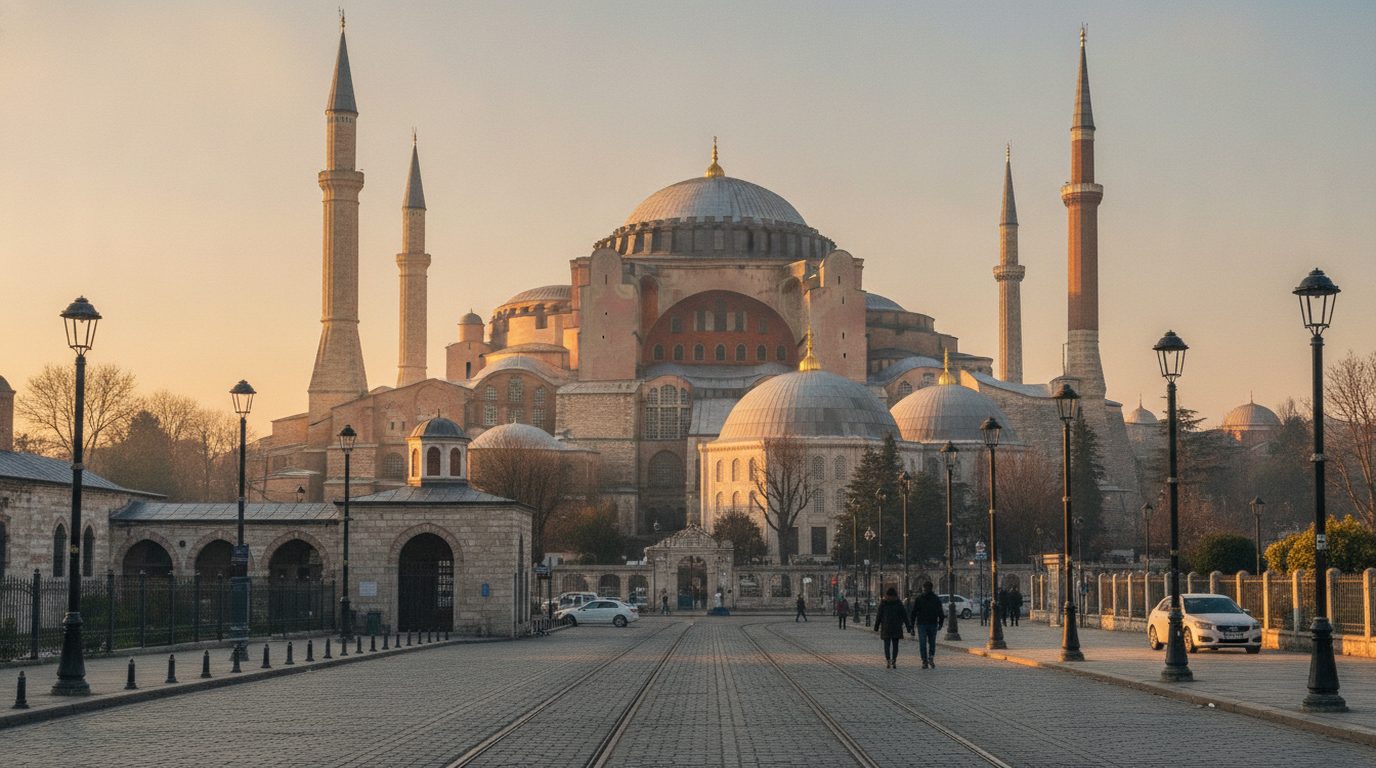
What you see coming back up: Hagia Sophia
The view from street level by the cistern entrance — Hagia Sophia is 150 metres away, which is why the two are Istanbul’s classic same-morning pairing.
The cistern’s strangest trick is context: you surface from Justinian’s underground reservoir onto a square dominated by the same emperor’s great church, finished five years after the cistern. Orient yourself by this view — the cistern entrance is diagonally opposite Hagia Sophia’s northwest corner.
Photographing it in person
The cistern is one of the most photogenic interiors in Istanbul and one of the hardest to shoot: the light is deliberately dim, the humidity fogs lenses for the first few minutes, and flash flattens everything it touches (keep it off — the amber lamps are the picture). Brace on a railing, expose for the highlights and let the shadows fall away. Personal photography is welcome; tripods and professional shoots need permission. For the stories behind these images, see the Medusa heads page, the what to see inside guide and the history of the cistern — and pick a quiet hour from the opening times, because an empty walkway is worth more than any camera.